
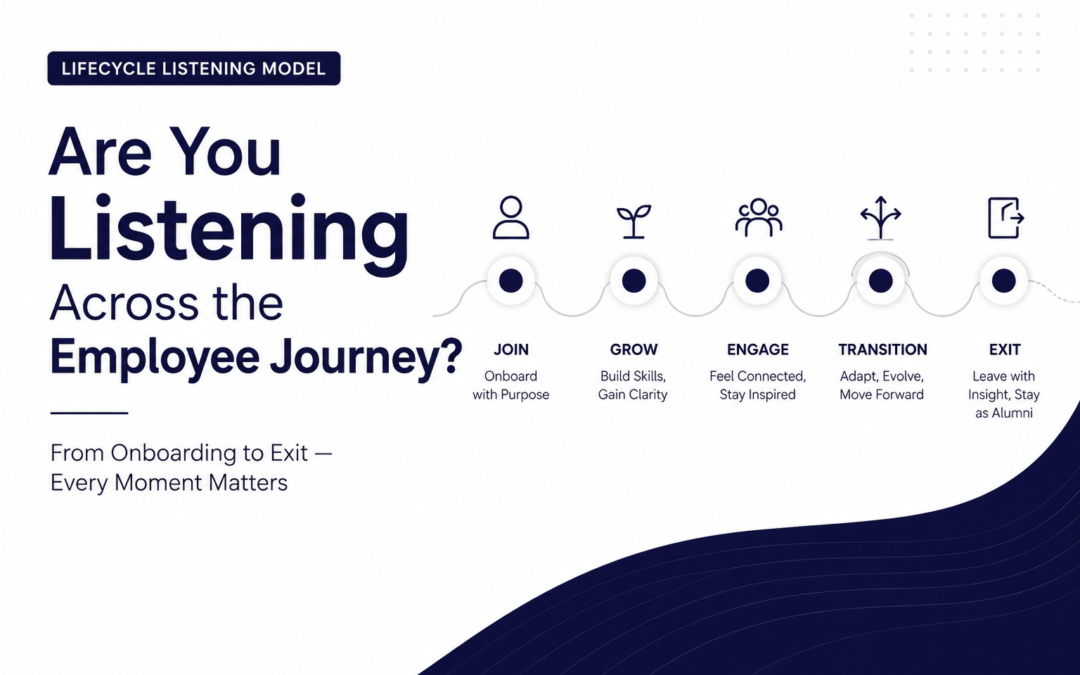
1. The Beginning: Every Employee Journey Starts with Promise
Every employee joins an organization with energy.
They arrive with:
- ambition
- curiosity
- expectations
- hope for growth
- a desire to contribute meaningfully
For organizations, every new hire represents possibility—new ideas, new capability, and future leadership potential.
But the employee journey does not stay static.
From the first day onward, experiences begin shaping how employees think, feel, engage, and perform.
And those experiences determine what follows:
Will they thrive?
Will they disengage?
Will they stay?
Will they grow?
Or will they quietly begin looking elsewhere?
The employee lifecycle begins long before attrition becomes visible.
It begins with experience.
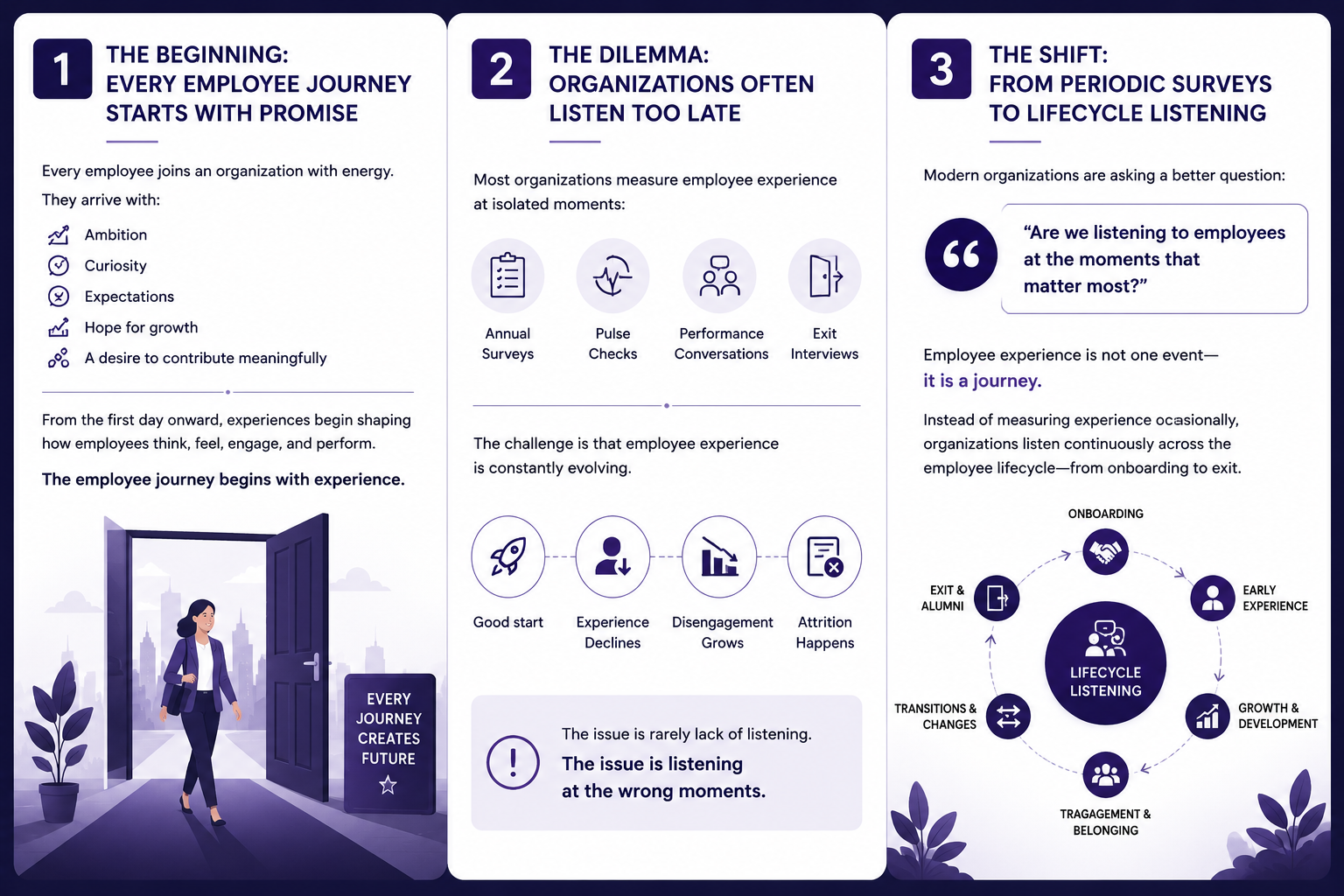
2. The Dilemma: Organizations Often Listen Too Late
Most organizations measure employee experience at isolated moments:
- Annual engagement surveys
- Periodic pulse checks
- Exit interviews
- Performance conversations
These listening moments provide useful insights—but only snapshots.
The challenge is that employee experience is constantly evolving.
A great onboarding experience can lead to strong engagement.
A poor manager interaction can reduce trust.
Lack of growth opportunities can slowly create disengagement.
Workplace change can influence commitment.
And by the time organizations notice the outcome—attrition, burnout, disengagement, or performance decline—the signals have already been there for months.
The issue is rarely lack of listening.
The issue is listening at the wrong moments.
3. The Shift: From Periodic Surveys to Lifecycle Listening
Modern organizations are asking a better question:
“Are we listening to employees at the moments that matter most?”
This changes listening from a survey program into a strategic experience model.
Because employee experience is not one event—
it is a journey.
And journeys should be understood across every important stage.
That is where the Lifecycle Listening Model creates value.
Instead of measuring experience occasionally, organizations listen continuously across the employee lifecycle—from onboarding to exit.
4. The Answer: What Is a Lifecycle Listening Model?
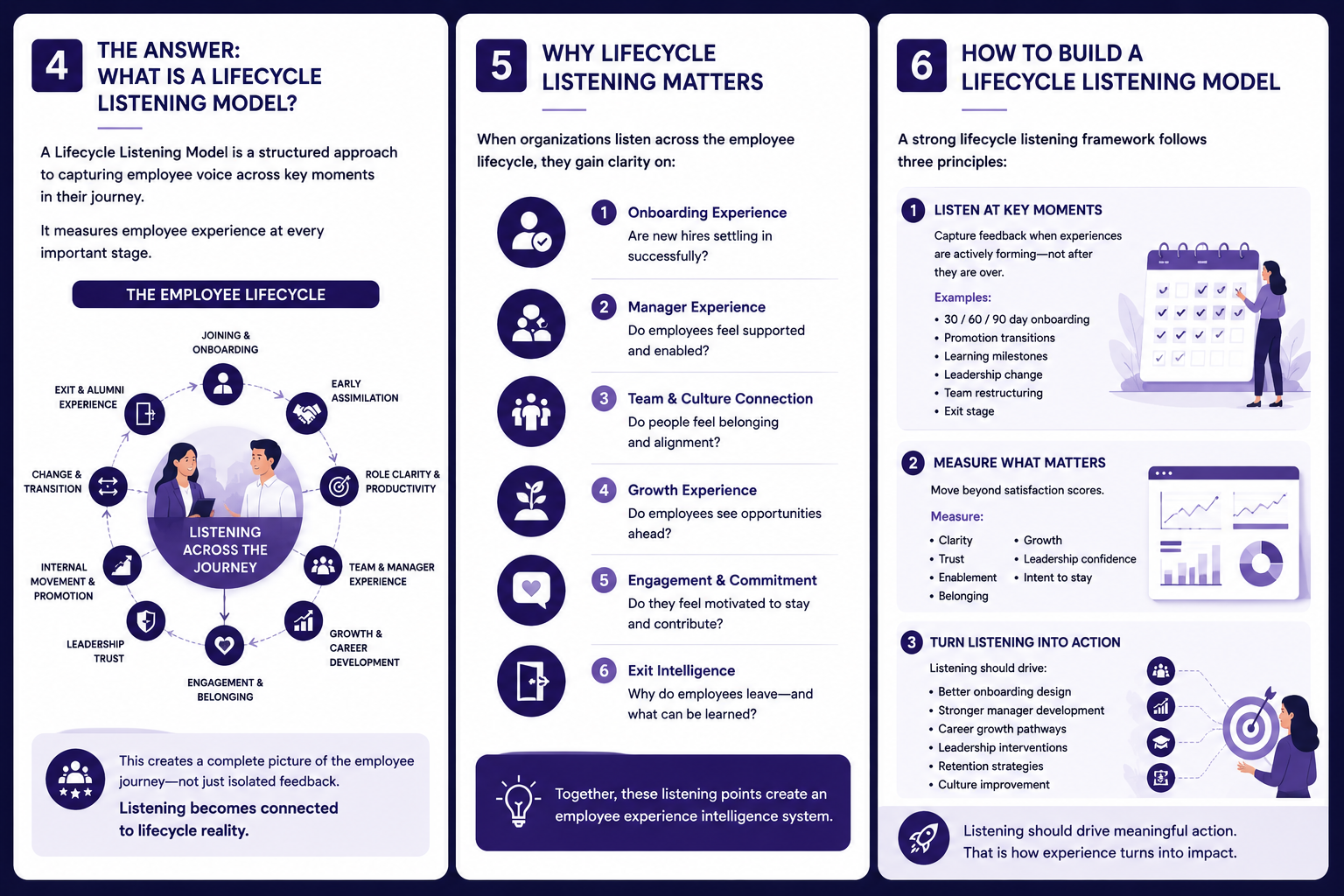
A Lifecycle Listening Model is a structured approach to capturing employee voice across key moments in their journey.
It measures employee experience at every important stage, such as:
- Joining & onboarding
- Early assimilation
- Role clarity & productivity
- Team & manager experience
- Growth & career development
- Engagement & belonging
- Leadership trust
- Internal movement & promotion
- Change & transition
- Exit & alumni experience
This creates a complete picture of the employee journey—not just isolated feedback.
Organizations begin understanding:
- what employees experience
- when experiences improve
- where friction begins
- which moments create loyalty
- what drives disengagement
- what strengthens retention
Listening becomes connected to lifecycle reality.
5. Why Lifecycle Listening Matters
When organizations listen across the employee lifecycle, they gain clarity on:
5.1 Onboarding Experience
Are new hires settling in successfully?
5.2 Manager Experience
Do employees feel supported and enabled?
5.3 Team & Culture Connection
Do people feel belonging and alignment?
5.4 Growth Experience
Do employees see opportunities ahead?
5.5 Engagement & Commitment
Do they feel motivated to stay and contribute?
5.6 Exit Intelligence
Why do employees leave—and what can be learned?
Together, these listening points create an employee experience intelligence system.
6. How to Build a Lifecycle Listening Model
A strong lifecycle listening framework follows three principles:
6.1 Listen at Key Moments
Capture feedback when experiences are actively forming—not after they are over.
Examples:
- 30 / 60 / 90 day onboarding
- Promotion transitions
- Learning milestones
- Leadership change
- Team restructuring
- Exit stage
6.2 Measure What Matters
Move beyond satisfaction scores.
Measure:
- clarity
- trust
- enablement
- belonging
- growth
- leadership confidence
- intent to stay
6.3 Turn Listening into Action
Listening should drive:
- better onboarding design
- stronger manager development
- career growth pathways
- leadership interventions
- retention strategies
- culture improvement
Feedback is most valuable when it creates meaningful action.
7. The Outcome: Better Employee Journeys
When organizations adopt lifecycle listening:
Employees feel:
- heard
- supported
- valued
- understood
- connected
Organizations gain:
- stronger onboarding success
- higher engagement
- better retention
- stronger culture
- lower early attrition
- improved employee trust
- actionable people intelligence
The employee journey becomes intentionally designed—not accidentally experienced.
8. The Organizational Value: Experience Becomes Business Intelligence
Lifecycle listening transforms employee feedback into strategic intelligence.
Organizations can understand:
- which stages create friction
- where trust is strongest
- when engagement declines
- what drives retention
- how leadership impacts experience
- where interventions matter most
This shifts employee listening from HR activity to business intelligence.
9. The Future: Listening Across the Entire Employee Lifecycle
The future of employee experience is not one annual survey.
It is not one engagement score.
It is not listening only when people leave.
The future is continuous lifecycle listening.
Because from onboarding to exit—
every employee moment matters.
And organizations that listen across that journey build:
- stronger cultures
- stronger managers
- stronger retention
- stronger employee experiences
- stronger organizations
Platforms like Lissen.io help organizations operationalize this model—turning lifecycle listening into structured insight, actionable intelligence, and better employee experiences across every stage of the journey.
When organizations listen better, employees experience better.
And when employees experience better, organizations perform better.