
Build a Workforce That Recommends Your Organization with Employee Advocacy Index (eNPS)
Understand how employees feel about your organization and how likely they are to recommend it as a place to work. QaizenX® by Lissen.io helps organizations measure eNPS, analyze drivers, and improve employee experience.
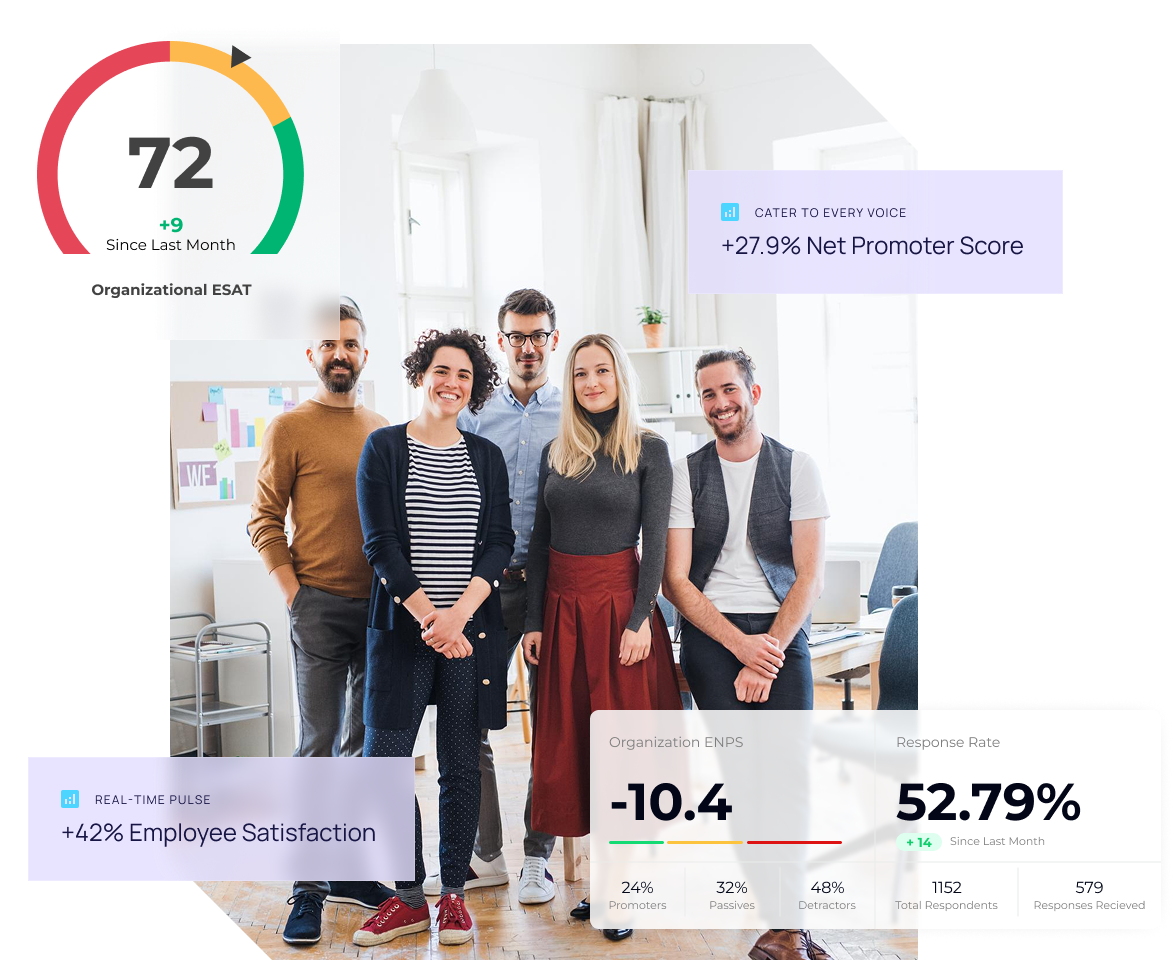
What is Employee Net Promoter Score (eNPS)?
Employee Net Promoter Score (eNPS) is a metric used to measure employee loyalty and advocacy.
It is based on a simple question:
“How likely are you to recommend this organization as a place to work?”
Employees respond on a scale from 0 to 10, and are grouped into three categories:
- Promoters (9–10): Highly engaged and loyal employees
- Passives (7–8): Satisfied but not fully engaged
- Detractors (0–6): Disengaged or unhappy employees

How to Calculate eNPS
eNPS is calculated using the following formula:
eNPS = % of Promoters − % of Detractors
The final score ranges from -100 to +100.
How to Interpret eNPS Scores
- Positive score (above 0): More promoters than detractors
- Strong score (above 30): Healthy engagement levels
- High score (above 50): Strong employee advocacy
- Negative score: Indicates disengagement and potential risk
eNPS should be analyzed over time and across teams to understand trends and patterns.
What is a Good eNPS Score?
eNPS scores range from -100 to +100, depending on the balance between promoters and detractors.
A “good” eNPS score varies by industry and organization, but general benchmarks are:
- Below 0: Indicates more detractors than promoters and signals potential engagement issues
- 0 to 30: Average
- 30 to 50: Good
- 50+: Excellent
Rather than focusing only on the score, organizations should focus on improving the drivers behind it.
Limitation of eNPS
While eNPS is widely used, it has limitations:

Does not explain why employees feel a certain way
Lacks context behind employee responses, making it hard to understand root causes.

May oversimplify employee experience
Reduces complex sentiments into a single score, missing deeper nuances.

Needs supporting data for deeper insights
Requires additional feedback and metrics to make insights actionable.

Sensitive to bias and timing
Results can be influenced by recent events or individual biases, affecting accuracy.
How QaizenX® Helps Measure and Improve eNPS
QaizenX® is the experience management platform by Lissen.io that helps organizations go beyond just measuring eNPS.
With QaizenX®, teams can:
Capture eNPS through structured surveys
Analyze trends across teams, roles, and lifecycle stages
Identify key drivers behind promoter and detractor groups
Combine eNPS with sentiment and engagement data
Take targeted actions to improve employee experience
What Actually Drives eNPS

Role clarity and expectations
Clear understanding of responsibilities helps employees stay focused and confident in their roles.

Manager support and communication
Strong guidance and open communication from managers drive trust and engagement.

Growth and development opportunities
Access to learning and career growth keeps employees motivated and committed.

Recognition and feedback
Regular appreciation and constructive feedback reinforce positive performance and engagement.

Workplace environment and culture
A supportive and inclusive culture enhances employee satisfaction and involvement.

Work-life balance and flexibility
Balanced workloads and flexibility help maintain energy, well-being, and sustained engagement.
Use Cases
Measure employee loyalty and advocacy
Identify disengaged employees
Improve employee engagement strategies
Track experience across lifecycle stages
Reduce attrition linked to low satisfaction
What is eNPS?
eNPS is a metric used to measure employee loyalty and likelihood to recommend the organization.
How is eNPS calculated?
It is calculated as the percentage of promoters minus the percentage of detractors.
What is a good eNPS score?
A score above 30 is generally considered good, while above 50 is strong.
Is eNPS enough to measure employee engagement?
No, it should be combined with other metrics and insights for a complete view.
What tools can be used to measure eNPS?
Platforms like QaizenX® by Lissen.io help capture, analyze, and improve eNPS effectively.
Start Improving eNPS
Measure, understand, and improve employee loyalty with QaizenX® by Lissen.io.