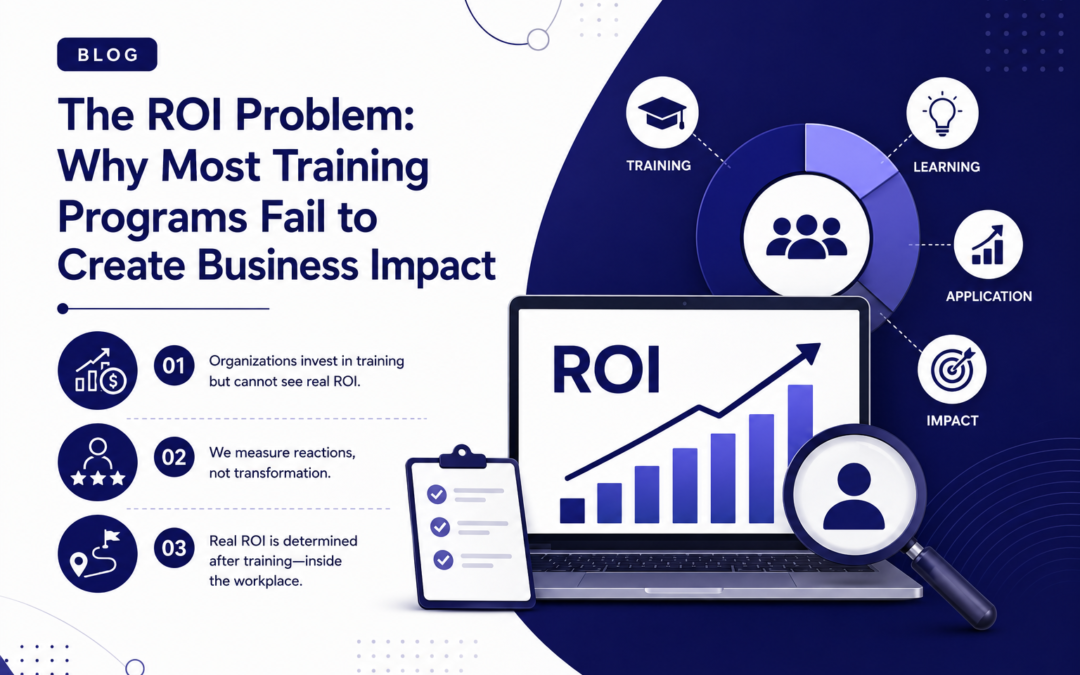
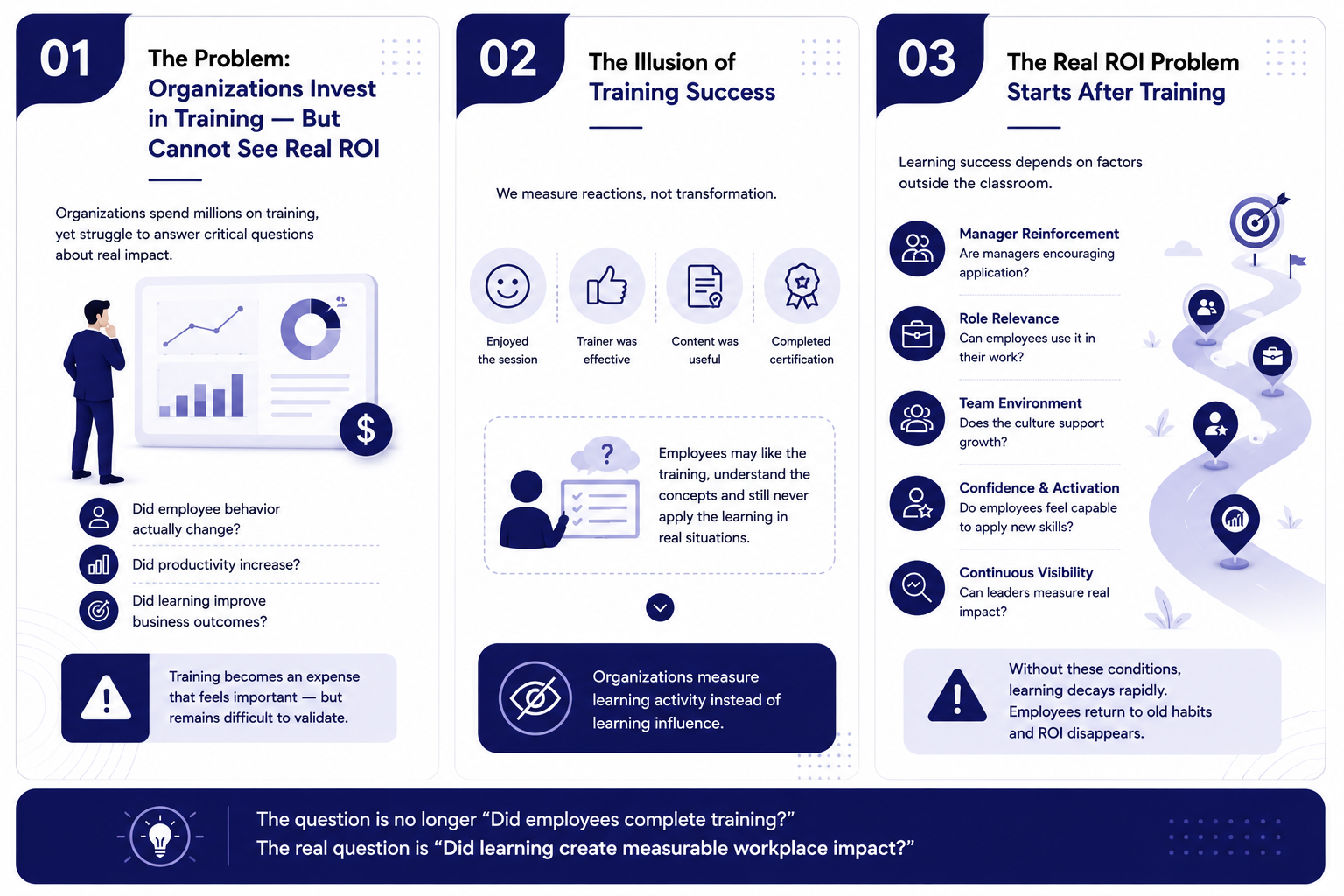
1. The Problem: Organizations Invest in Training — But Cannot See Real ROI
Organizations spend heavily on:
- Leadership development
- Technical upskilling
- Compliance programs
- Sales enablement
- Behavioral capability training
The expectation is simple:
Better learning should improve business performance.
But once training ends, leadership teams struggle to answer fundamental questions:
- Did employee behavior actually improve?
- Are managers seeing meaningful change?
- Has productivity increased?
- Did learning influence business outcomes?
Most organizations cannot answer these questions with confidence.
Because traditional learning systems only measure:
- Attendance
- Completion rates
- Feedback forms
- Certification scores
These metrics indicate participation.
Not impact.
The result:
Training becomes an expense that feels important — but remains difficult to validate.
2. The Illusion of Training Success
Most training evaluations focus on immediate reactions:
- “Was the session engaging?”
- “Did employees enjoy the workshop?”
- “Was the trainer effective?”
These measurements create a perception of success.
But learning effectiveness is not determined inside the classroom.
It is determined after employees return to work.
An employee may:
- Complete the training
- Understand the concepts
- Provide positive feedback
…and still never apply the learning meaningfully in real situations.
This creates a major disconnect:
Organizations measure learning activity instead of learning influence.
3. The Real ROI Problem Starts After Training Ends
The biggest challenge is not delivering training.
It is ensuring that learning survives in the workplace.
Whether training creates business value depends on multiple organizational factors:
Manager Reinforcement
Are managers encouraging employees to apply learning consistently?
Role Relevance
Can employees immediately connect learning to their responsibilities?
Team Culture
Does the environment support experimentation and improvement?
Confidence & Activation
Do employees feel capable enough to apply new skills?
Continuous Visibility
Can leaders measure whether learning is translating into performance?
Without these conditions:
Learning decay happens rapidly.
Employees gradually return to old behaviors.
And organizations lose visibility into why training failed.
4. The Shift: From Training Delivery to Learning Intelligence
Traditional organizations treat training as an event.
Modern organizations are beginning to treat learning as a continuous intelligence system.
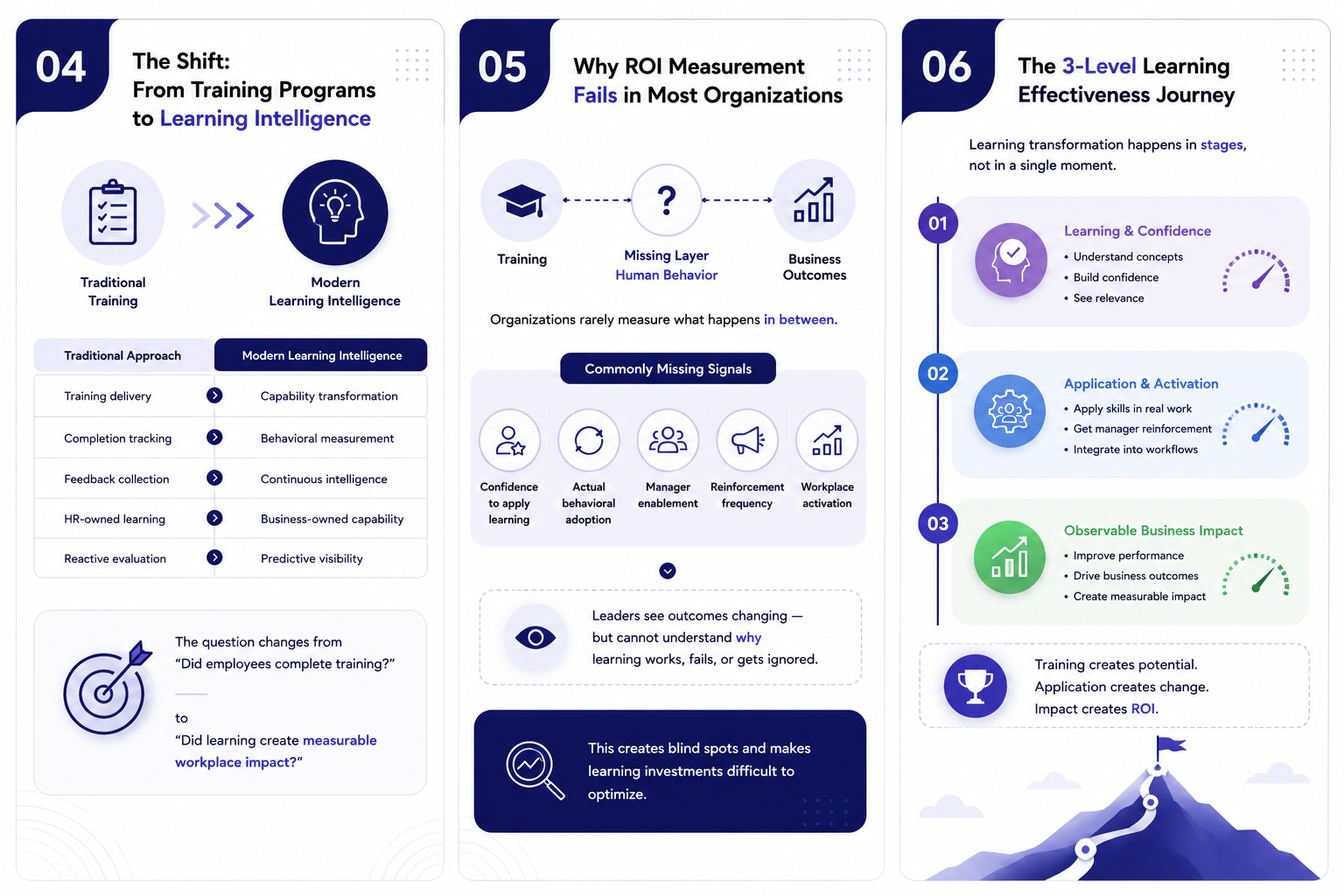
The shift looks like this:
|
Traditional Training |
Modern Learning Intelligence |
|
Course completion |
Capability transformation |
|
Feedback collection |
Behavioral measurement |
|
Periodic evaluation |
Continuous visibility |
|
HR process |
Business performance driver |
|
Reactive reporting |
Predictive intelligence |
The key question changes from:
“Did employees complete training?”
to
“Did learning create measurable workplace impact?”
This shift is becoming increasingly important as organizations look for clearer visibility into workforce capability development.
5. Why Traditional ROI Models Fail
Most ROI calculations attempt to directly connect:
Training → Business Outcomes
But there is a missing layer in between:
Human behavior.
Organizations rarely measure:
- Confidence to apply learning
- Actual workplace adoption
- Manager enablement
- Reinforcement frequency
- Behavioral consistency
Without this layer, leadership teams can see outcomes changing —
but cannot understand:
- Why some programs succeed
- Why others fail
- Which managers enable adoption
- Which teams struggle with activation
- Where learning breakdowns occur
This is where many organizations lose visibility into actual learning effectiveness.
6. The 3-Level Learning Effectiveness Journey
Effective learning transformation typically follows a progressive journey.
Level 1: Learning & Confidence
Employees understand concepts and feel confident using them.
Signals include:
- Knowledge clarity
- Learning confidence
- Practical understanding
- Relevance perception
At this stage, learning exists as potential.
Level 2: Application & Activation
Learning begins influencing workplace behavior.
Organizations observe:
- Skill application
- Behavioral adoption
- Workflow integration
- Manager reinforcement
- Collaboration improvement
This stage determines whether learning survives beyond training delivery.
Level 3: Observable Business Impact
Learning begins creating measurable organizational outcomes.
Signals may include:
- Productivity improvement
- Better execution quality
- Increased engagement
- Improved leadership effectiveness
- Reduced operational errors
This is where training starts becoming measurable business value.
7. The Emerging Need for Continuous Learning Intelligence
Organizations are increasingly realizing that one-time surveys and static evaluations are no longer enough.
They need continuous visibility into:
- Learning confidence
- Application behavior
- Manager reinforcement
- Performance influence
- Business impact progression
This is where modern approaches like continuous learning intelligence frameworks are becoming relevant.
Rather than relying only on post-training feedback, organizations are starting to measure how learning evolves over time.
8. Measuring Learning Beyond Completion
Some organizations are beginning to adopt structured frameworks that aggregate learning signals into measurable intelligence models.
For example, approaches such as the Learning Intelligence Index™ (LII™) by Lissen.io aim to help organizations understand:
- Whether employees are activating learning
- Where adoption gaps exist
- How managers influence effectiveness
- Which programs create measurable impact
Instead of viewing learning as isolated events, these systems evaluate learning progression continuously across multiple dimensions.
This creates greater visibility into whether training investments are translating into capability growth.
9. Managers: The Hidden Variable Behind ROI
One of the strongest predictors of learning success is not the training content itself.
It is the manager.
Even well-designed learning programs often fail when managers:
- Do not reinforce behaviors
- Ignore post-training application
- Prioritize execution over coaching
- Fail to create accountability
Conversely, strong managers amplify learning effectiveness significantly.
This is why modern learning intelligence approaches increasingly measure:
- Reinforcement quality
- Coaching consistency
- Behavioral enablement
- Team activation support
Because training effectiveness is rarely isolated from managerial influence.
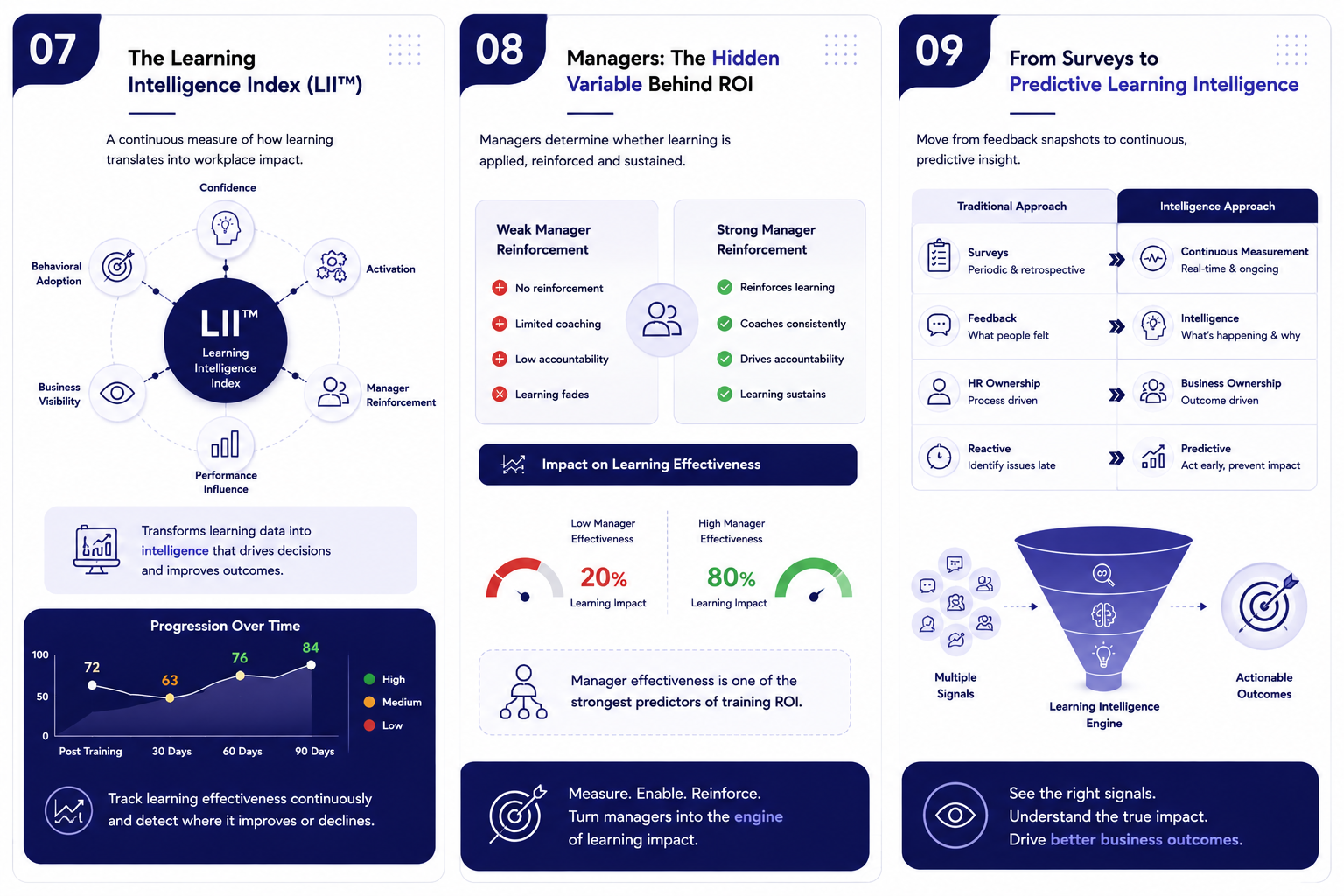
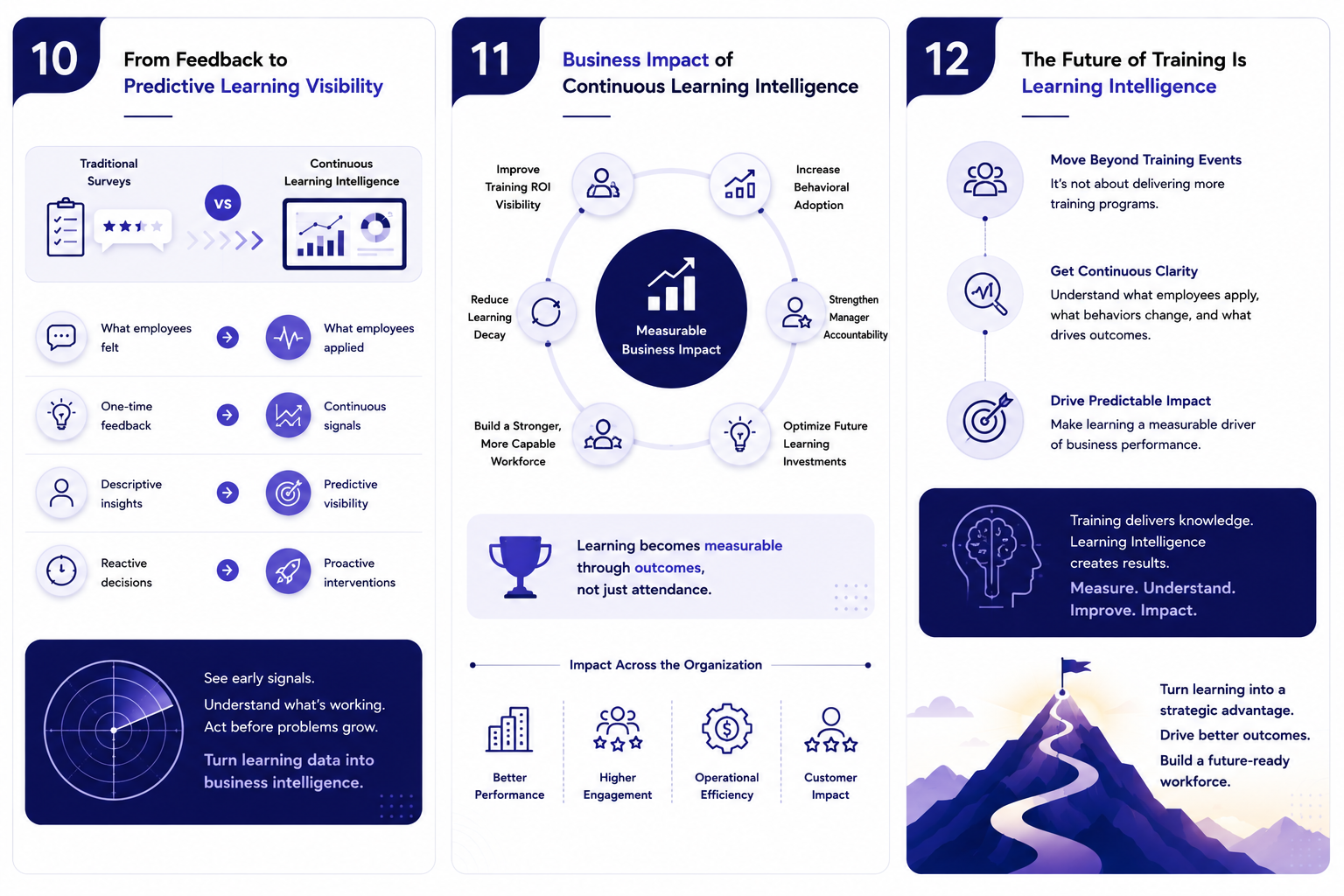
10. From Feedback to Predictive Learning Visibility
Traditional surveys tell organizations what employees felt.
Modern learning intelligence systems attempt to understand:
- What employees applied
- What behaviors changed
- What learning influenced outcomes
- What risks are emerging
- What interventions may be required
This creates a shift from:
Feedback collection
to
Predictive learning visibility
Organizations gain earlier signals into whether learning investments are likely to succeed or fail.
11. Business Impact of Continuous Learning Intelligence
Organizations adopting continuous learning intelligence approaches can potentially:
- Improve ROI visibility
- Reduce learning decay
- Increase behavioral adoption
- Strengthen manager accountability
- Improve capability development
- Optimize future learning investments
- Build measurable workforce intelligence
Most importantly:
Learning becomes measurable through workplace outcomes — not just attendance.
12. Conclusion: The Future of Training Is Continuous Learning Intelligence
The future is not about delivering more training programs.
It is about continuously understanding:
- What employees actually apply
- Which behaviors change
- Which managers enable success
- Which programs create measurable impact
Organizations that continue measuring only attendance and satisfaction will struggle to prove ROI.
Organizations that build continuous visibility into learning effectiveness will gain:
- Better workforce intelligence
- Stronger capability development
- Improved business performance
- More measurable learning outcomes
Because real training ROI is not defined by:
How many employees attended learning sessions.
It is defined by:
How effectively learning transformed workplace performance.
And that is the direction modern learning intelligence frameworks — including approaches like Lissen.io’s Learning Intelligence Index™ (LII™) — are beginning to enable.