
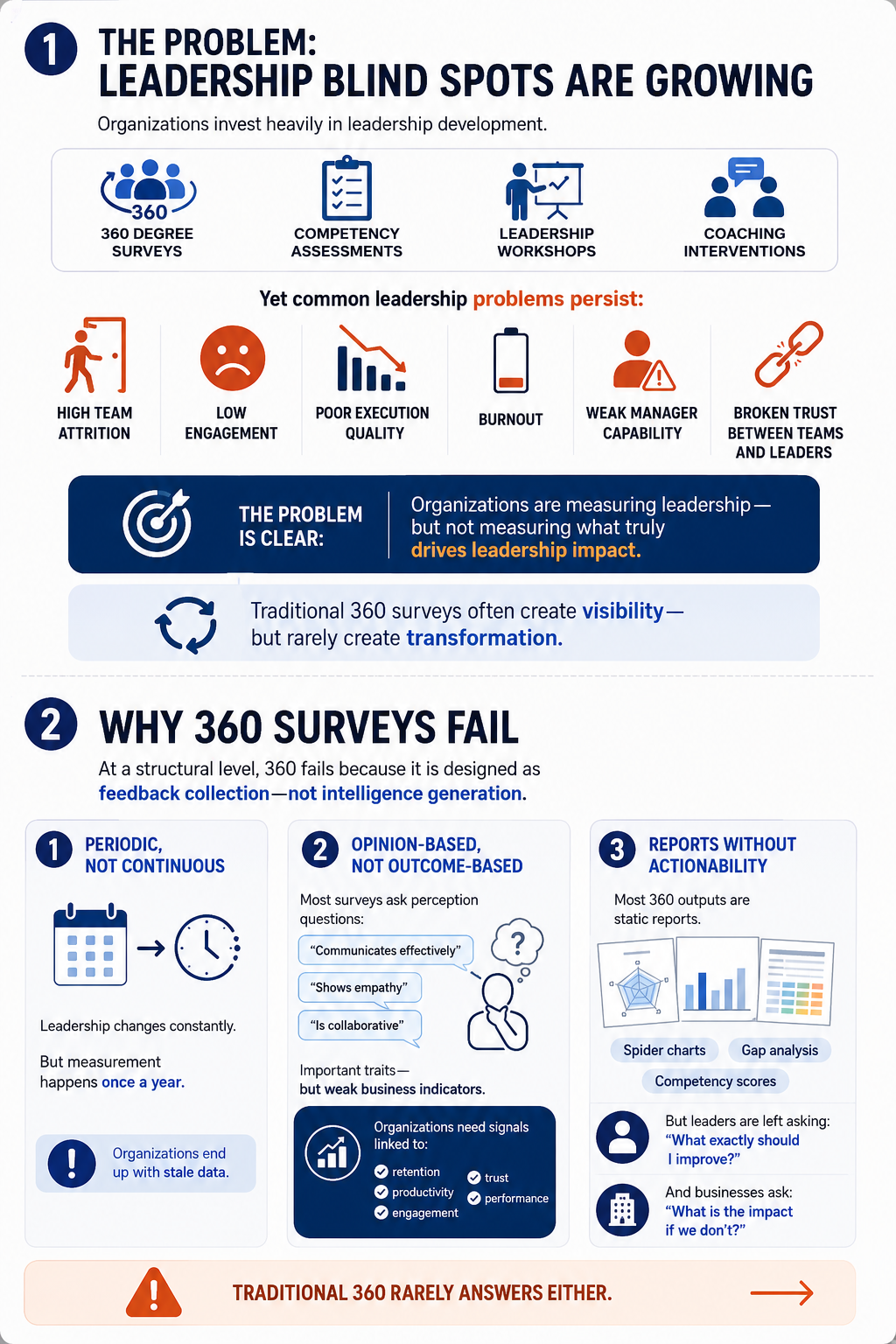
1. The Problem: Leadership Blind Spots Are Growing
Organizations invest heavily in leadership development.
They run:
- 360 degree surveys
- competency assessments
- leadership workshops
- coaching interventions
Yet common leadership problems persist:
- High team attrition
- Low engagement
- Poor execution quality
- Burnout
- Weak manager capability
- Broken trust between teams and leaders
The problem is clear:
Organizations are measuring leadership—but not measuring what truly drives leadership impact.
Traditional 360 surveys often create visibility—
but rarely create transformation.
2. Why 360 Surveys Fail
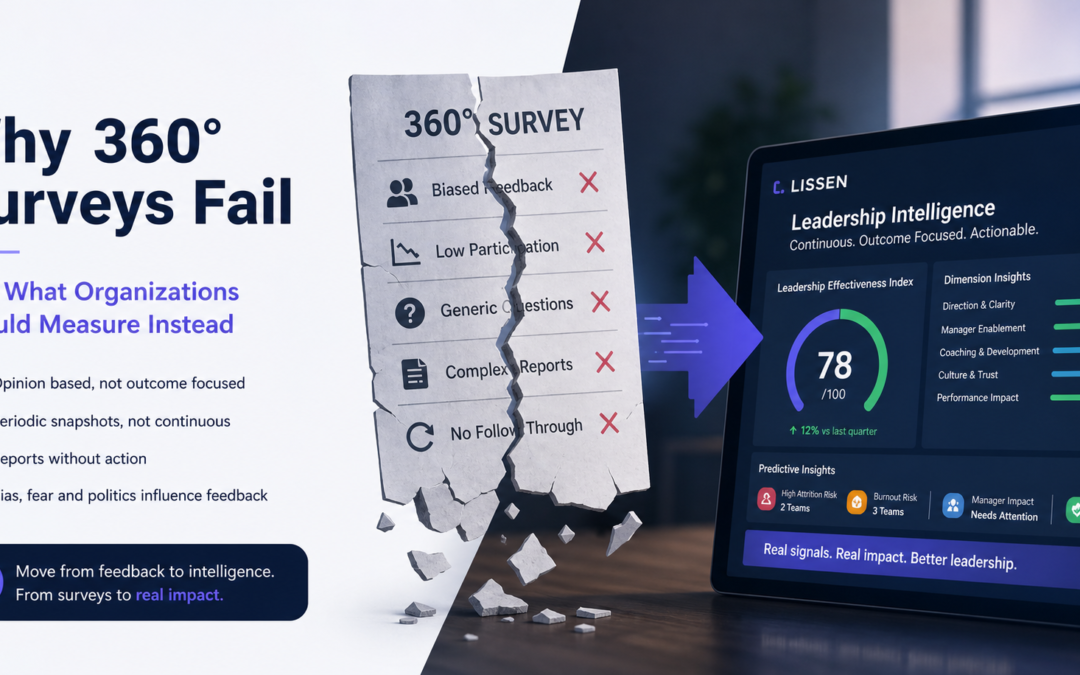
At a structural level, 360 fails because it is designed as feedback collection—not intelligence generation.
Problem 1: Periodic, Not Continuous
Leadership changes constantly.
But measurement happens once a year.
Organizations end up with stale data.
Problem 2: Opinion-Based, Not Outcome-Based
Most surveys ask perception questions:
- “Communicates effectively”
- “Shows empathy”
- “Is collaborative”
Important traits—
but weak business indicators.
Organizations need signals linked to:
- retention
- productivity
- engagement
- trust
- performance
Problem 3: Reports Without Actionability
Most 360 outputs are static reports.
Spider charts.
Gap analysis.
Competency scores.
But leaders are left asking:
“What exactly should I improve?”
And businesses ask:
“What is the impact if we don’t?”
Traditional 360 rarely answers either.
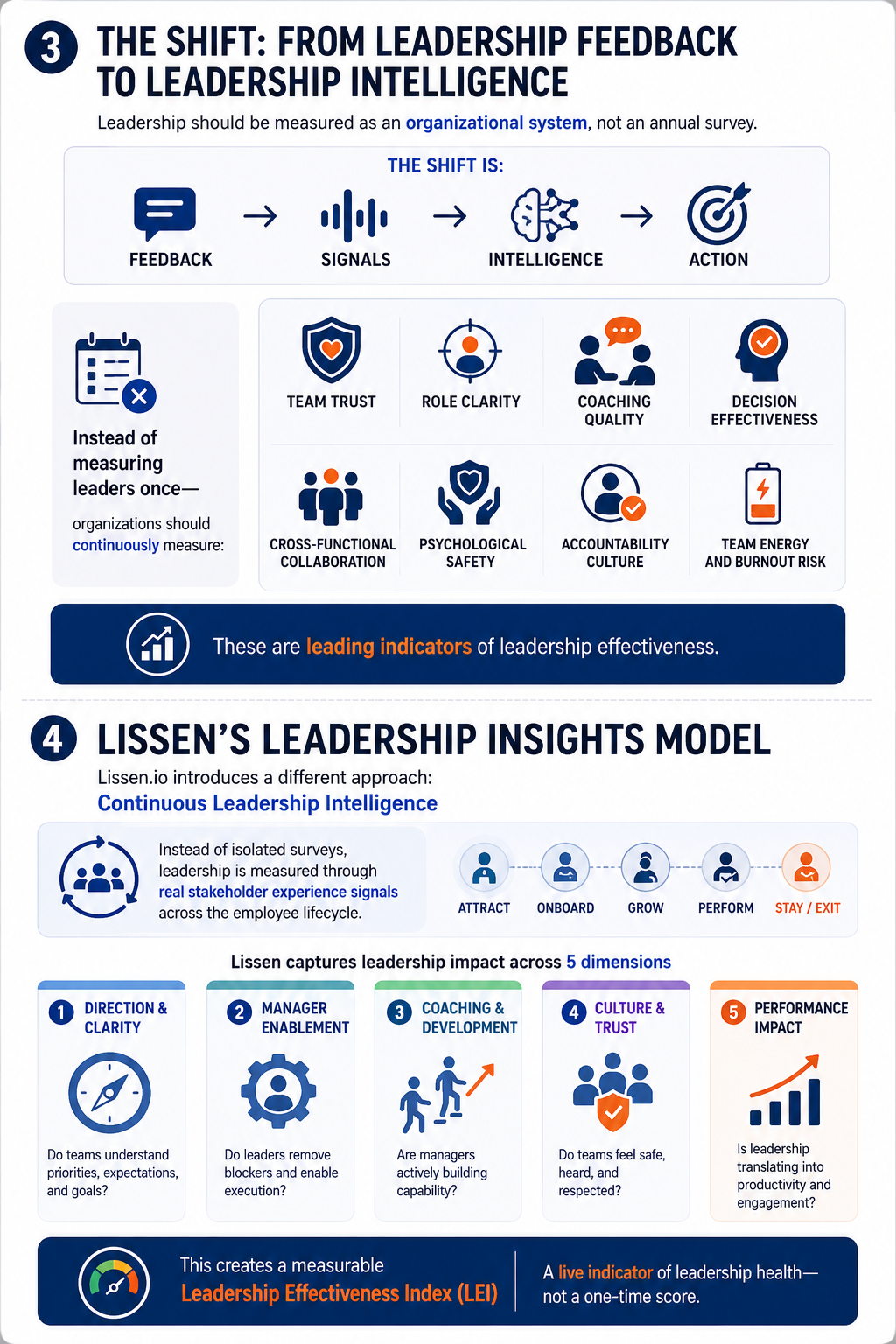
3. The Shift: From Leadership Feedback to Leadership Intelligence
Leadership should be measured as an organizational system, not an annual survey.
The shift is:
Feedback → Signals → Intelligence → Action
Instead of measuring leaders once—
organizations should continuously measure:
- Team trust
- Role clarity
- Coaching quality
- Decision effectiveness
- Cross-functional collaboration
- Psychological safety
- Accountability culture
- Team energy and burnout risk
These are leading indicators of leadership effectiveness.
4. Lissen’s Leadership Insights Model
Lissen.io introduces a different approach:
Continuous Leadership Intelligence
Instead of isolated surveys, leadership is measured through real stakeholder experience signals across the employee lifecycle.
Lissen captures leadership impact across 5 dimensions
1. Direction & Clarity
Do teams understand priorities, expectations, and goals?
2. Manager Enablement
Do leaders remove blockers and enable execution?
3. Coaching & Development
Are managers actively building capability?
4. Culture & Trust
Do teams feel safe, heard, and respected?
5. Performance Impact
Is leadership translating into productivity and engagement?
This creates a measurable Leadership Effectiveness Index (LEI)
A live indicator of leadership health—
not a one-time score.
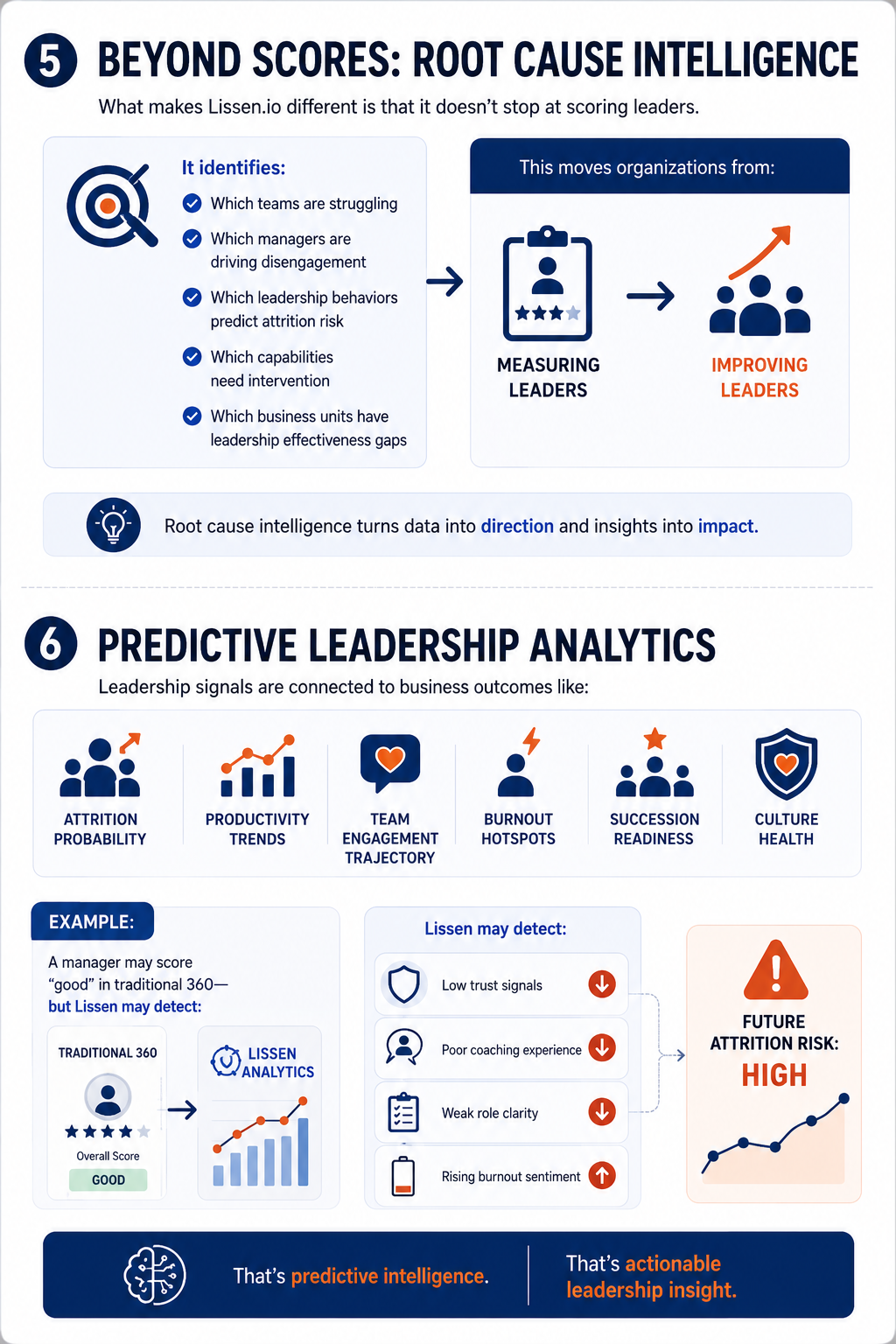
5. Beyond Scores: Root Cause Intelligence
What makes Lissen.io different is that it doesn’t stop at scoring leaders.
It identifies:
Which teams are struggling
Which managers are driving disengagement
Which leadership behaviors predict attrition risk
Which capabilities need intervention
Which business units have leadership effectiveness gaps
This moves organizations from:
measuring leaders → improving leaders
6. Predictive Leadership Analytics
Leadership signals are connected to business outcomes like:
- Attrition probability
- Productivity trends
- Team engagement trajectory
- Burnout hotspots
- Succession readiness
- Culture health
Example:
A manager may score “good” in traditional 360—
but Lissen may detect:
- low trust signals
- poor coaching experience
- weak role clarity
- rising burnout sentiment
👉 Future attrition risk: High
That’s predictive intelligence.
That’s actionable leadership insight.
7. Business Impact
Organizations using Lissen.io for leadership intelligence can:
- Improve manager effectiveness
- Reduce avoidable attrition
- Increase team productivity
- Strengthen leadership pipelines
- Improve employee trust
- Build stronger workplace culture
- Detect leadership risks early
Leadership becomes measurable through outcomes—
not assumptions.
8. Conclusion: The Future Is Continuous Leadership Intelligence
360 surveys created awareness.
But awareness alone doesn’t improve organizations.
The future belongs to organizations that can continuously answer:
What experience are leaders creating?
What business impact will that produce?
What action should be taken now?
That is leadership intelligence.
That is measurable.
That is actionable.
That is where Lissen.io helps organizations lead better.